
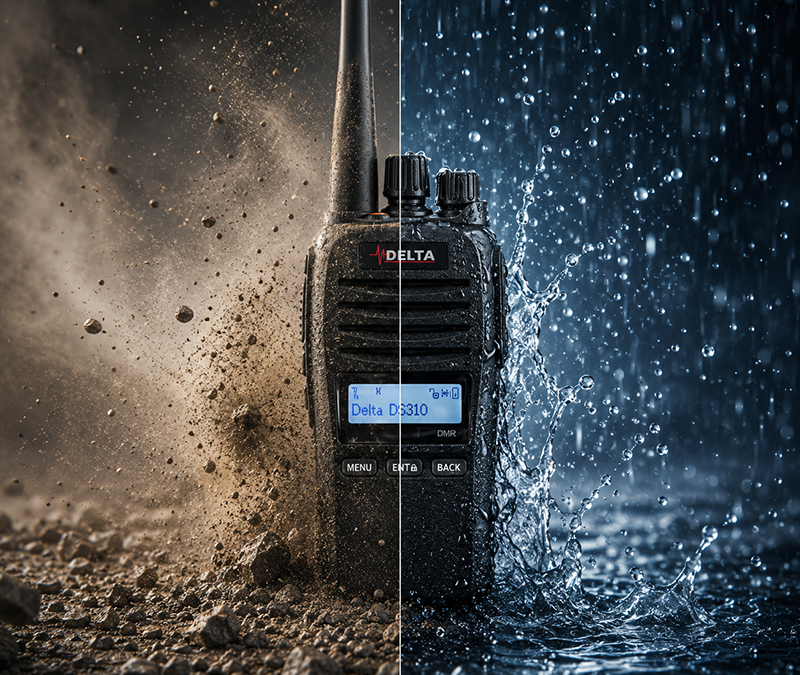
When you’re comparing two-way radios, you’ll see codes like IP54, IP67 or IP68 in the specs. That’s the radio’s IP rating — and it tells you exactly how well the radio resists dust and water. Understanding it is the difference between buying a radio that survives your worksite and one that dies in the first downpour. Here’s the plain-English guide.
What does IP stand for?
IP means Ingress Protection (sometimes called International Protection). It’s an international standard — IEC 60529 — that replaces vague marketing words like “waterproof” or “rugged” with a precise, lab-tested code. Importantly, manufacturers can’t just assign an IP rating themselves; it has to be verified by independent testing.
How to read an IP rating
An IP rating is the letters “IP” followed by two digits, for example IP67:
- First digit (0–6) = protection against solids (dust, dirt, fingers, tools).
- Second digit (0–9) = protection against liquids (drips, spray, jets, immersion).
So IP67 means dust-tight (6) and protected against temporary immersion (7). If you see an X — like IPX7 — it simply means that category wasn’t tested, not that it has zero protection.
First digit: dust & solids protection
| Digit | Protection |
|---|---|
| 0 | No protection |
| 1 | Objects larger than 50 mm (e.g. a hand) |
| 2 | Objects larger than 12.5 mm (e.g. a finger) |
| 3 | Objects larger than 2.5 mm (tools, thick wires) |
| 4 | Objects larger than 1 mm (most wires, screws) |
| 5 | Dust-protected — limited dust may enter, but not enough to affect operation |
| 6 | Dust-tight — no dust ingress at all |
For solids, the rating is cumulative — a “6” covers everything below it.
Second digit: water protection
| Digit | Protection |
|---|---|
| 0 | No protection |
| 1 | Dripping water (falling vertically) |
| 2 | Dripping water when tilted up to 15° |
| 3 | Spraying water (up to 60° from vertical) |
| 4 | Splashing water from any direction |
| 5 | Low-pressure water jets from any direction |
| 6 | Powerful water jets from any direction |
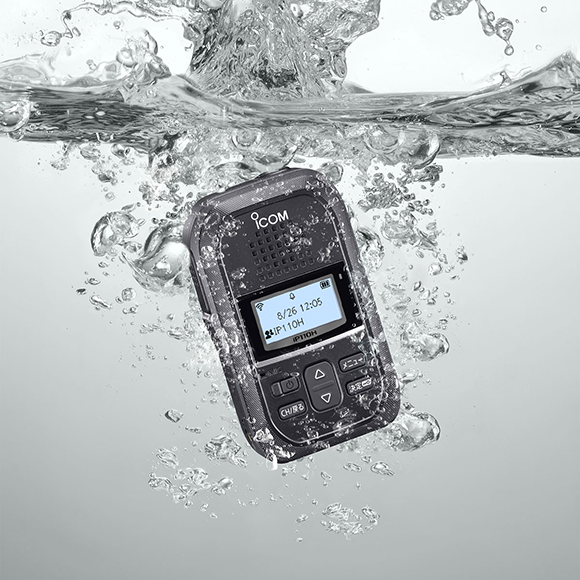
| 7 | Temporary immersion — up to 1 m deep for 30 minutes |
| 8 | Continuous immersion beyond 1 m (depth/time set by the manufacturer) |
| 9 / 9K | High-pressure, high-temperature jets (industrial wash-down) |
Three things people get wrong about IP ratings
1. Water ratings are NOT cumulative. A higher second digit doesn’t automatically include the ones below. An IP67 radio passed the immersion test — but that doesn’t mean it passed the high-pressure jet test (IP66). Immersion and jets are completely different physical tests. Where a device needs both, you’ll see a dual rating like IP66/IP68.
2. IP68 isn’t a fixed number. For IP68, the manufacturer defines the exact depth and duration — one IP68 device might be rated to 1.5 m for 30 minutes, another to greater depths. Always check the spec sheet, not just the code.
3. IP tests use fresh water only. The rating says nothing about saltwater, chemicals or steam — important if you’re using a radio around the ocean. Even a high-rated radio should be rinsed with fresh water after saltwater exposure. IP ratings also don’t cover impact or drops — that’s a separate standard (MIL-STD-810 or IK).
What IP rating do you need for a two-way radio?
IP54–IP55 (dust-protected + splash/jets): fine for indoor, retail, hospitality and light commercial use where the radio won’t be soaked or buried in dust.
IP67 (dust-tight + 1 m immersion): the sweet spot for tough environments — construction, 4WD, farming, mining, marine and outdoor work. Dust can’t get in, and the radio survives being dropped in water. This is why leading rugged handhelds like the GME XRS-660 and the Delta AS310/AS320 carry IP67.
IP68 (continuous immersion): for the harshest, wettest conditions where a radio may be submerged longer or deeper.
As a rule: if the radio lives outdoors, on a worksite, or near water, don’t go below IP67.
IP rating vs MIL-STD-810
IP ratings only cover dust and water. Many professional radios also carry a MIL-STD-810 rating, which tests shock, vibration, drops and temperature extremes. A radio with both (e.g. IP67 and MIL-STD-810G) is built to survive both the elements and rough handling — ideal for demanding commercial use.
Frequently asked questions
What IP rating is waterproof?
Strictly, no radio is permanently “waterproof” — it’s water-resistant to a tested level. IP67 protects against temporary immersion (1 m for 30 minutes); IP68 protects against continuous immersion to a manufacturer-specified depth.
Is IP68 better than IP67?
For water immersion, yes — but not always necessary. If your radio will only face rain, dust and the occasional splash or drop, IP67 is usually plenty and more cost-effective. Choose based on your environment, not just the bigger number.
What does the X mean in IPX7?
It means the solids (dust) protection wasn’t tested or declared — not that it has none. IPX7 tells you about water resistance only.
Which radio is right for me?
Match the rating to the environment: IP54–55 for indoor/light use, IP67 for outdoor, worksite, 4WD, marine and industrial use, IP68 for the wettest conditions. Not sure? Our team will point you to the right one.
Need a radio built for your conditions? Radio Industries has matched Australians to the right two-way radio since 1985. Call 1300 266 682 or browse rugged handheld radios.

Recent Comments